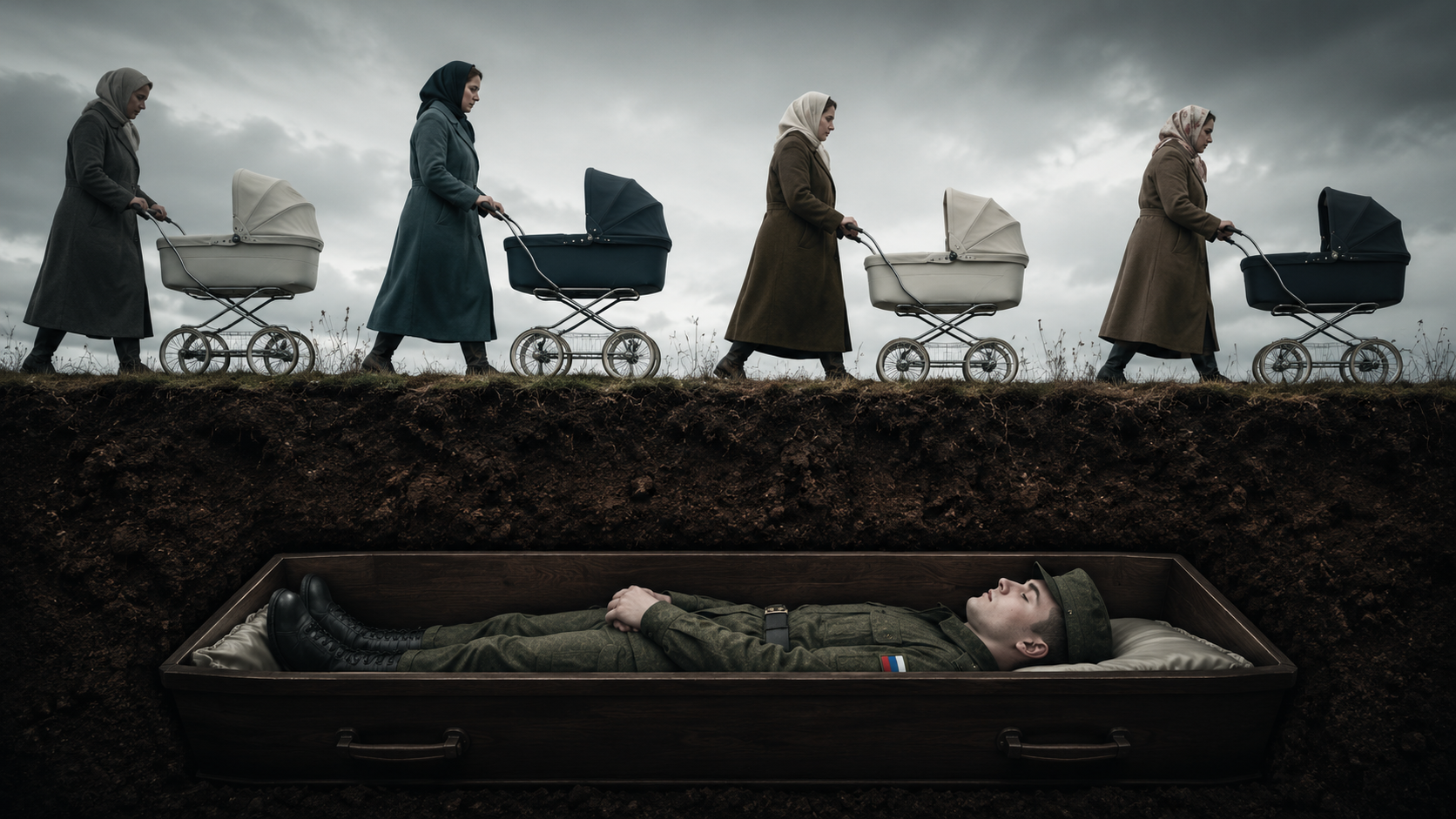
In the first week of the war a Russian soldier sent his mother a message from somewhere inside Ukraine, and a few days later Ukraine's ambassador to the United Nations held the screenshot up to the chamber and read it into the record. The boy had been told he was going on exercises. He wrote that there was a real war here, that he was frightened, that they were shelling everyone, even civilians. They call us fascists, Mama, he wrote. This is so hard. When she asked whether she could send him a parcel, he answered that the only thing he wanted now was to die. He was killed, the ambassador said, moments after the last message. The exchange was verified only by Ukrainian sources, and I will not pretend otherwise — but the genre is past dispute. In those same weeks the BBC was filling with Russian mothers describing sons who had disappeared into "drills and more drills and then we go home" and returned in the zinc boxes the army calls Cargo-200.
Hold the boy in mind. The rest of this is the calculation that spent him, and the calculation is colder than any madness, and it may also be correct.
Set the question the way the man making it would. Not "is the war good," which is a child's question, but: do you want a fragile peace now and a worse slaughter later, or do you pay in blood now for a future your grandchildren survive? Framed that way it stops being lunacy and becomes a wager — the oldest and coldest a state can place — and the only serious objection to it is not that it is evil but that it might be right.
The threat the wager hedges against is not invented. NATO has moved east without a pause for a quarter of a century: Poland and the Baltics, then nearly the whole of the old Warsaw bloc, the 2008 summit declaration that Ukraine and Georgia "will become" members, and then — after the invasion meant to forestall exactly this — Finland and Sweden into the alliance as well, doubling Russia's frontier with it. George Kennan, who understood Moscow better than anyone left in Washington, warned at the very outset of the expansion that it was a tragic error which would in time light the fuse of a new cold war and provoke the Russians in precisely the direction their history already inclined them. To a state seated on a plain with no natural border — the same flat corridor Napoleon crossed toward Moscow, and Hitler after him, the lesson unaltered in the century between — an armed alliance creeping toward the one gap in the map is not paranoia. It is the recurring nightmare arriving on its usual schedule.
And the means of holding that gap have thinned with each turn of the regime. A Tsar bought his buffer as a peer among peers, by marriage and treaty and the quiet partition of smaller nations. The Soviets, having lost the seat at that table, bought it by owning their neighbors outright under a doctrine that reserved the right to send tanks the moment one of them strayed. The present state has neither — no place among equals, no creed that anyone volunteers to host — and so it reaches for the last and crudest tool on the rack, seizure, and takes its buffer by force, because force is the only instrument it has left.
Here the arithmetic turns genuinely cold, and the state's own conduct will show you it has run the same sum. A nation replaces itself through its women: births are women multiplied by fertility, and the men do not enter the equation. A society can lose a generation of them and scarcely lower its ceiling, because one man fathers across many, and what the absent men cost is not children but the households that would have raised them — a social wound, not a biological one, and a social wound a state can dress by making itself the provider in the missing man's place. So in the ledger Russia keeps, young men are the single resource it can spend without spending the future. They are the surplus.
Watch where the state actually closes its grip, and you will see it agrees. Russia's birthrate has fallen to roughly 1.4 children per woman, a two-hundred-year low; in 2024 its deaths outran its births by some six hundred thousand. Putin has named this, flatly, a matter of national survival, and warned that the country faces extinction if the trend is not turned. The measures follow the logic of the ledger with a candor that is almost clarifying. In late 2024 it became a finable offense to promote a child-free life — "childfree propaganda," the law calls it. Abortion has been squeezed shut at the regional level. And in the spring of 2026 the Health Ministry issued guidance instructing doctors, during routine examinations, to ask women how many children they intend to have, and to refer any woman who answers none to a psychologist, for the express purpose of cultivating a positive attitude toward motherhood. The same questionnaire is given to men. The men's version does not ask the question.
That asymmetry is the entire thesis pressed into a single bureaucratic form. The state has located the binding constraint on its own survival, and the constraint is not its men — its men it will conscript, spend, and bury — but its women's willingness to bear. So it sends the men to the front and the women to the therapist. One column is expendable and the other is the future, and the policy does not trouble itself to disguise which is which.
This is the part that is almost beautiful, and I will not insult you by pretending I cannot feel the pull of it. Spend the few you can spare to hold the line; answer the plain in the only currency it has ever accepted; preserve the many, and the women who carry them, against a century that is coming for every nation's numbers. Laid out in clean lines it takes the shape of sacrifice, and sacrifice is the most beautiful arithmetic our species has ever devised.
Then there is the boy's message.
It does not argue with the arithmetic. It does something the arithmetic has no operation for. It insists that the boy in the spendable column was the whole of a world — frightened, lied to, nineteen, sick for a kitchen he would not see again — and that a future "protected by strong Russian men" is laid, every course of brick, out of boys who texted their mothers about drills. You can total a cohort. You cannot total fear and longing for home; that sum does not exist, and a room of schoolchildren will fall silent when one such message is read aloud, not because they have grasped geopolitics but because they have grasped its exact opposite — that the smallest true thing weighs more than the largest abstract one, and that the air goes out of a room when the two are set side by side.
Both of these are true at once, and there is no honest vantage from which either cancels the other. The wager may balance. NATO's pressure is real and unbroken; the plain is still indefensible; a Russia that lets its numbers collapse while a hostile alliance settles onto its border may indeed face, in thirty years, a reckoning that makes this war look thrifty. A man who chooses the cheaper slaughter now is not, by the cold light of the ledger, wrong — and that is the horror native to the thing. Not that the math is insane. That it may come out even. The boy's message does not make the math wrong. It makes the man who can run the math, and act on it, and feel the pull of its beauty, into precisely the kind of man who can sit across a table from that mother and spend her son anyway.
The war is winding down now, whatever the day's strikes suggest — the parades scaled back to almost nothing, the pauses brokered, the prisoners exchanged in their thousands — while the territorial demand has not shifted by a kilometer and a full ceasefire is still refused. That asymmetry is the tell. Tempo falling, aims held: this is a man banking his buffer and stanching the bleeding, not a man conceding the field. If Russia trades the land away, I have read it wrong. Until then, the wager is simply being collected.
Which leaves the man himself, and he is best drawn as he is rather than as either side would prefer him. Vladimir Putin thinks in a unit of time his contemporaries have forgotten how to use. While other leaders govern toward the next election, he governs toward the next century — against the curve of a population graph, in the name of a state he holds to be older and more durable than any life inside it, his own included. That long sight is real, and rare, and it is the faculty his enemies most reliably underestimate. It is also inseparable from the coldness, because they are one faculty and not two: no man plans in centuries who has not first taught himself to read the people in front of him as entries in a column. He can gather the soldiers' mothers and tell them, on state television, that he shares their grief, and he is not lying — he has merely signed the order that emptied the chair beside each of them, and feels no contradiction, because from the altitude at which he reads the country there is none to feel. He is not the madman his opponents require, nor the steward his admirers conjure. He is the rarer and less bearable thing: a man fully equal to the arithmetic the plain demands, who pays it in his nation's sons without a tremor, who feels the beauty of the sum and is not stopped by it, and who may, in the long accounting, turn out to have been right. The graph is in his hands. The boys are in the column. He has never once confused the two.