Dalton Eatherly, who calls himself Chud the Builder, walks up to strangers with a camera and a slur and waits for the predictable. The predictable obliges. He films it. He uploads it. He banks the subscribers. Somewhere in Tennessee a courthouse shooting attaches attempted-murder paper to his name, and the discourse arrives on schedule to ask whether he was the aggressor or the aggrieved, as if the question were interesting. It is not. He is an idiot across every axis that matters — tactical, strategic, intellectual, rhetorical, moral — and his idiocy is not the subject of this piece. The reactions he harvests are not the subject either. The reactions are dull. The reactions are foreseeable. A grown man reduced to homicide over syllables is not a revelation; it is a weather report.
The subject is what surrounds the reactions. The interpretive layer. The atmosphere. The collective shrug, the rationalization machinery, the fundraising apparatus, the academic exoneration, the ritualized contextualizing of overkill until the corpse is the one on trial. The zeitgeist. That is the diagnostic. That is what carries weight. Predictable individual blow-ups reveal nothing in isolation. What reveals everything is the consensus that builds around them — the cultural operating system that has decided, without ever putting the question to a vote, that lethal response to irritation is a matter for explanation rather than condemnation. A society can survive the existence of provocateurs. A society can survive the existence of thin-skinned citizens. No society survives the conviction, transmitted from its commanding heights to its sidewalks, that the proper response to friction is the kind of violence that ends with a body and the proper response to the body is a press release about context.
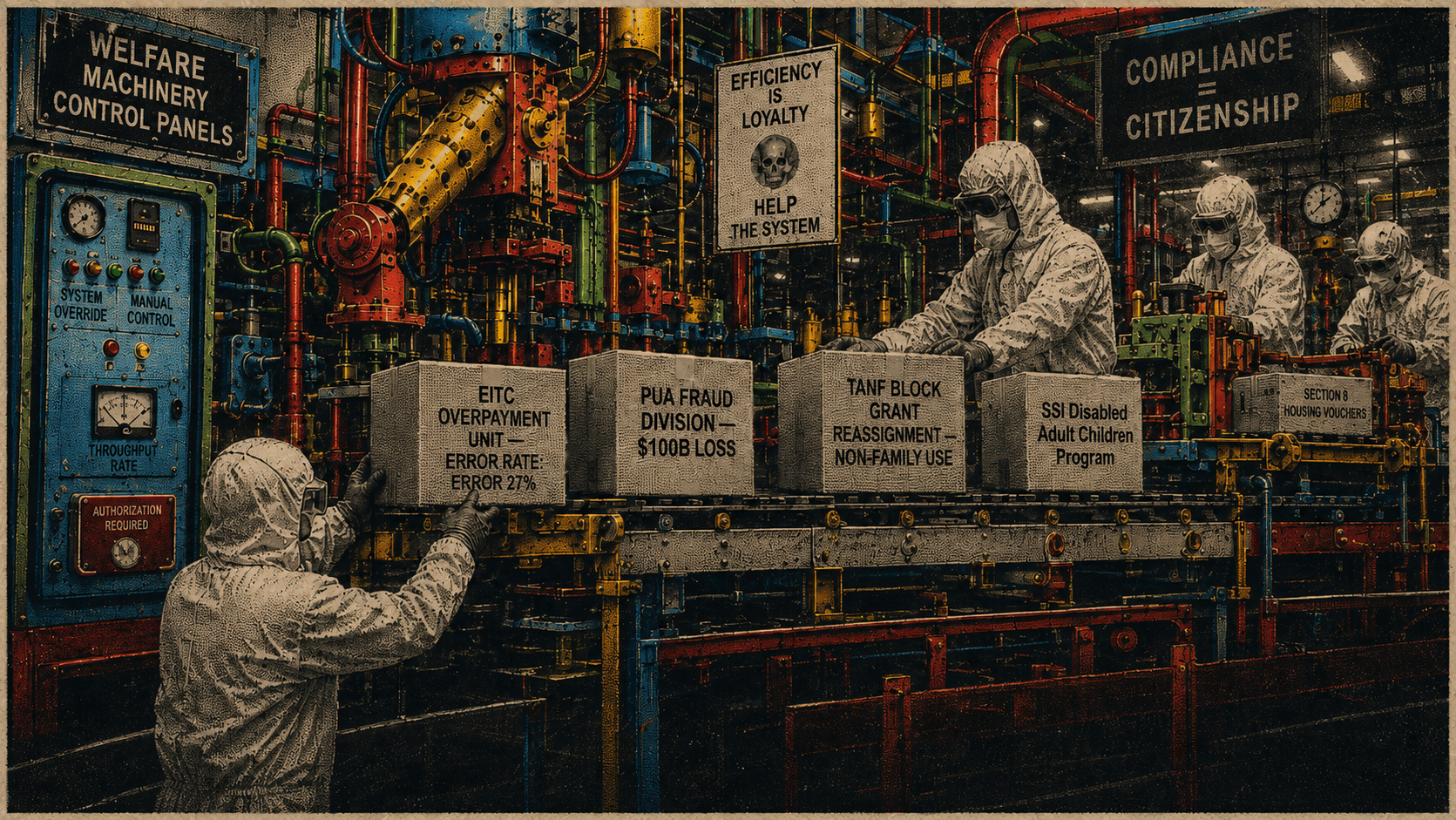
This atmosphere did not arrive. It was manufactured. It is the deliberate output of a regime of unilateral kindness applied for sixty years to a population that was never consulted about whether it wished to be the object of such kindness. Welfare without strings. Affirmative protection without reciprocal demand. Therapeutic language replacing accountable language. Lowered standards passed off as equity. Speech codes that pathologize observation. A media reflex trained to translate perpetrator into victim before the body is cold. An academy that built careers on the theology of permanent injury. A jurisprudence that discovered new categories of harm faster than the harms could be inflicted. Federal money flowing into the offices of professionals whose continued employment depended on the wound never closing. Foundations whose endowments compounded in proportion to the dysfunction they pledged to alleviate. A whole class of administrators, consultants, diversity officers, public health researchers, and grant writers whose mortgages are paid by the maintenance of the very pathology their grant applications promise to address. The result is not generosity. The result is a population processed into legibility-as-other, granted the developmental privileges of permanent minors, denied the dignity of being held to the standards every other adult must navigate. The kindness is the assault. The compassion is the wound. And the brittleness it produced — the thin skin, the high time preference, the escalation thresholds that detonate at provocations most populations absorb without thinking — is the iatrogenic phenotype of the helping hand.
I once watched a bodycam clip of a drunk woman who had thrown her shoe at a police officer. She was arrested. She begged for forgiveness on the way to the cruiser, sober enough to understand what she had done and what was about to happen. No prosecutor in the jurisdiction wanted to pursue charges. The arrest itself was the sentence. The booking, the processing, the cell, the hours of fluorescent light and concrete and the bureaucracy of consequence — that was the medicine. She would not throw shoes at officers again. The proximate friction of accountability had done its work in a single night. This is how a functioning society modulates behavior. Not through programs. Not through curricula. Through the immediate, unambiguous, unsentimental application of consequence delivered by people standing within arm's reach. The drunk woman was treated as an adult. She was permitted the dignity of being responsible for her own shoe. The system that arrested her assumed she was capable of learning, and she was. Compare this to sixty years of policy designed around the premise that an entire population cannot be expected to learn, cannot be held to ordinary standards, cannot survive the friction that the drunk woman survived in a single night and was better for. Compare it and weep.
The public watches the clips. The public registers the strangeness. The public does not know what it is looking at. It sees what appears to be a malfunctioning response and concludes that the responders ought to behave differently. This is the indifference. Not malice — indifference. The stark, ambient ignorance of what was done. The civic body has been asked to share streets, schools, juries, neighborhoods, and futures with a population whose developmental track was deliberately deformed by the state and its auxiliaries, and the civic body has not been told. It has been told the opposite. It has been told that what it is observing is either an illusion produced by its own prejudice or a residue of injuries inflicted by someone else, anyone else, never the regime currently administering the wound. To live in harmony with what the state has produced, the public would first have to be permitted to see it. The zeitgeist exists precisely to prevent that seeing. Its function is not to inform the public but to manage the public's perception of what the public is itself perceiving, to insert a layer of mandatory misreading between the citizen's eye and the citizen's brain. The clips circulate. The misreadings circulate faster. The misreadings are subsidized; the readings are punished. A man who says what he saw loses his job. A man who says what he was told to see keeps it and is promoted.
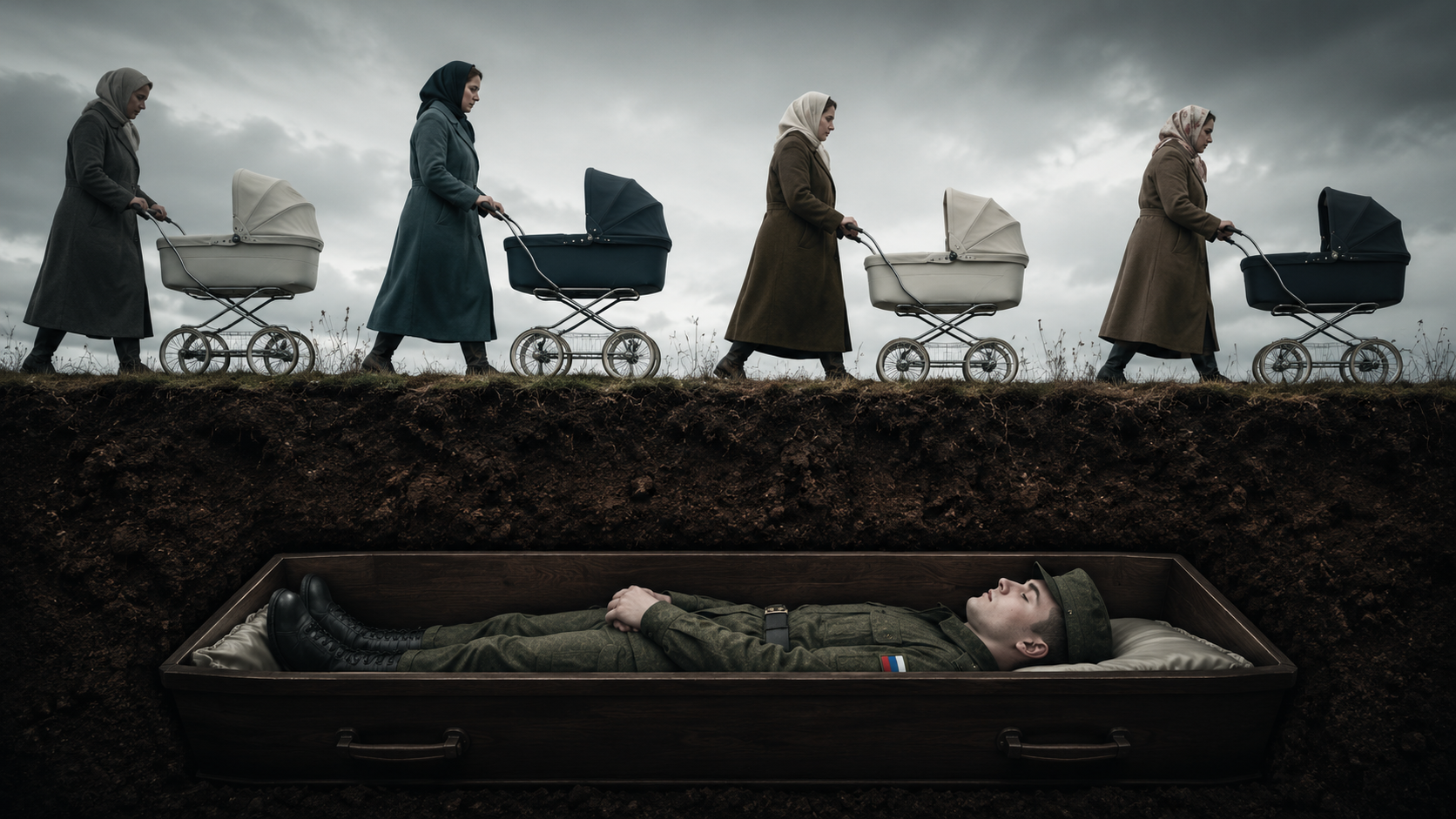
And Chud — the supposed antagonist of this arrangement, the supposed truth-teller in clown paint — suffers from the identical operation in reverse. He looks at the reactions and sees rational agents whom he has cleverly exposed. He sees nothing. He does not know that he is poking a population shaped by the same apparatus that shaped him, an apparatus that gave him no covenant architecture, no proximate accountability, no father at the dinner table to break a chair across his back when he announced his career plans. He is the other intake valve of the same machine. The otherness he projects onto his targets is the otherness that was projected onto him — the assumption that he, too, is a thing to be processed rather than a person to be raised. He is not exposing the zeitgeist. He is one of its products mocking another of its products for the camera. Consider what is required to produce a Chud. A young man with enough free time to roam streets baiting strangers. No trade demanding his hours. No wife requiring his presence. No children depending on his composure. No neighbor with standing to ask what he thinks he is doing. No father, present or remembered, whose voice would have intervened between the impulse and the upload. The same vacuum that produced the brittle reactions on the other side of the camera produced the lens itself. The machine consumes him as enthusiastically as it consumes the people he provokes. The amusement his audience feels at the spectacle is the amusement of recognizing the legibility of the engineered, and the audience does not know that either. They are watching two outputs of one factory and applauding the one that flatters their priors. Tomorrow the factory will produce more of both, and the audience will still be applauding, and the factory will still be operating on the funds the audience has, through its taxes and its silence, agreed to provide.
The proper architecture has a name, and it has had the name for as long as there have been names. Marriage as covenant. Children raised inside it. Neighbors who know the children. Community as the outer ring, never the substitute for the inner ones. God's love is the absolute that orders the hierarchy and makes it intelligible, but the hierarchy is not a denominational program; it is the operating system of every civilization that has ever endured. The state did not displace this architecture by accident. It displaced it by design, because the architecture is the only structure that produces sovereign adults, and sovereign adults are not clients. A grown man with a wife, children, a trade, and neighbors who would notice if he disappeared does not throw shoes at police officers. He does not detonate at syllables. He does not require a curriculum on stoicism because the conditions of his life have already taught him. He has been required to absorb a thousand small humiliations weekly — a colicky infant at three in the morning, a wife's exhaustion, a customer's complaint, a bill arriving on the wrong day — and the absorption has built in him the capacity to absorb the next one. The covenant generates what no program can generate and what every program quietly competes against. It generates citizens whose existence does not require state mediation, and the state, like any organism, regards that which renders it unnecessary as a threat.
The state's project for sixty years has been to install itself in the place that covenant used to occupy. It has done so under the banner of help, and the help has been the instrument. The proximate has been replaced by the distant. The father has been replaced by the check. The neighbor has been replaced by the case manager. The community has been replaced by the bureaucracy. The pastor has been replaced by the therapist, and the therapist has been replaced by the algorithm, and the algorithm has been replaced by the helpline that routes the call to a contractor in a different time zone reading from a script written by a consultant who has never met the caller and never will. Each replacement is sold as a refinement. Each replacement attenuates the bandwidth of accountability until what remains is a transactional shadow of the relationships it has supplanted. And the population subjected to the most concentrated dose of this substitution is now treated, by the very regime that administered it, as a sacred object whose dysfunction must never be named honestly because naming it would expose the regime. The zeitgeist is the gag order. The indifference is the public's compliance with a gag order it does not know it has signed.
There is no program that fixes this. The pathology is the program. The instinct of every reformer is to prescribe more of the medicine that produced the illness, more sensitivity, more funding, more frameworks, more rehabilitation, more grant cycles, more NGOs subsisting on the wound. Each layer thickens the insulation. Each layer further severs the proximate accountability that is the only mechanism by which human beings, in any population, on any continent, in any century, have ever recovered the traits that make civilization possible. Alcoholics Anonymous works because it reconstructs, in folding chairs and church basements, the proximity the state abolished. A man stands and names what he has done. Other men who have done the same thing tell him the truth about what he has said. A sponsor calls at midnight when the craving rises. None of this scales. None of this can be franchised. None of this can be measured by the metrics that grant officers require, which is precisely why it works and precisely why the rehab-industrial complex, with its billing codes and its outcome reports and its retention statistics, cannot replicate it and has no interest in trying. Distant compassion does not work. Distant compassion has never worked. Distant compassion is the disease wearing the costume of the cure.
Therefore: starve it. Refuse the spectacle. Refuse the framing. Refuse the language that turns observation into bigotry and accountability into harm. Refuse the client economy. Refuse the program that promises to help in exchange for the surrender of agency. Marry. Stay married. Raise children who can name what was done to the people around them without flinching and without contempt. Know your neighbors — not the abstract noun, but the human beings whose driveways adjoin yours, whose children play with yours, whose absence at the mailbox on a Tuesday would register as anomaly worth investigating. Build the architecture the state has spent sixty years dismantling and let the dismantling apparatus encounter, in your household and your block, a wall it cannot pass. The zeitgeist is not omnipotent. It dies wherever it meets a structure it cannot enter. Every intact covenant is a node it loses. Every father present is a transmission it cannot intercept. Every neighbor who knows your children's names is a surveillance the state cannot replicate and cannot corrupt. The machine has scale on its side. The covenant has reality on its side. Reality is patient and reality is undefeated and reality has buried more regimes than any regime has buried citizens.
Chud will be processed by the court system or he will not. The reactions will keep coming or they will not. The clips will trend or they will not. None of it matters. The machine that produced both sides of the spectacle continues to run, and it runs on attention, on participation, on the steady supply of citizens who do not know what was done and therefore cannot withhold what it requires. Withhold it. Let the clips die in silence. Let the apparatus encounter a population that has stopped feeding it. The civilization that comes out the other side will be the one that remembered the order: covenant, children, neighbor, community. The one that forgot will be the one that kept arguing about provocateurs while the zeitgeist did what it was built to do.
Never feed the machine. Starve it.